Darstellung:
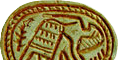
Within an oval frame is a scene composed of an ibex, a human figure in front of it and two
t (or plano-convex) signs above the animal’s back; (for the capride and the human figure see
Pendlebury/James 1962 [Perachora]: 510 fig. 38,679;
Hölbl 1979: II Taf. 108,925 [Cuma, 8th cent. BCE]; cf. also
Keel 1997b: Achsib Nr.
109 for a Haematite version).
Hölbl 1979: Hölbl G., 1979, Typologische Arbeit bei der Interpretation von nicht klar lesbaren Skarabäenflachseiten: SAK 7, 89-102.
Keel 1997b: Keel O., 1997b, Corpus der Stempelsiegel-Amulette aus Palästina/Israel. Von den Anfängen bis zur Perserzeit. Katalog Band I: Von Tell Abu Faraǧ bis ˓Atlit. With Three Contributions by Baruch Brandl (OBO.SA 13), Freiburg Schweiz/Göttingen.
Pendlebury/James 1962: Pendlebury J.D.S./James T.G.H, 1962, The Egyptian Type Objects, in: Payne H./Dunbabin T.J., Perachora. The Sanctuaries of Hera Akraia and Limenia. Excavations of the BSAE at Athens, 1930-1933. Vol. II: Pottery, Ivories, Scarabs, and Other Objects from the Votive Deposit of Hera Limenia, Oxford, 461-516.
Bibliographie:
Keel 1997b: 74f, Achsib Nr. 157.
Keel 1997b: Keel O., 1997b, Corpus der Stempelsiegel-Amulette aus Palästina/Israel. Von den Anfängen bis zur Perserzeit. Katalog Band I: Von Tell Abu Faraǧ bis ˓Atlit. With Three Contributions by Baruch Brandl (OBO.SA 13), Freiburg Schweiz/Göttingen.