Darstellung:
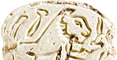
Ein schreitender Stier mit gesenktem Kopf wird von zwei Löwen gleichzeitig von vorn und von hinten angegriffen; die Schwänze der Löwen sind S-förmig gebogen (vgl.
Walters 1926: 50 und pl. 7 Nr. 415f;
Boardman 1968: 123f mit Anm. 16;
Boardman 1970: pl. 295 [ganz genaue Parallele];
Barnett/Mendleson 1987: pl. 62a,18/16 [Tharros];
Gubel 1988: Nr. 4), Kerbbandumrandung.
Barnett/Mendleson 1987: Barnett R.D./Mendleson C., eds., 1987, Tharros. A Catalogue of Material in the British Museum from Phoenician and other Tombs at Tharros, Sardinia, London.
Boardman 1968: Boardman J., 1968, Archaic Greek Gems. Schools and Artists in the Sixth and Early Fifth Centuries BC, London.
Boardman 1970: Boardman J., 1970, Greek Gems and Finger Rings. Early Bronze Age to Late Classical, London.
Gubel 1988: Gubel E., 1988, Phoenician Seals in the Allard Pierson Museum, Amsterdam (CGPH 3): RSF 16, 145-163.
Walters 1926: Walters H.B., 1926, Catalogue of Engraved Gems and Cameos, Greek, Etruscan and Roman in the British Museum, London.
Bibliographie:
Culican 1968: 51f, pl. 1:2 (= Culican 1986: 212f);
Culican 1986: 212f (= Culican 1968: 51f mit pl. 1:2);
Keel 1997b: 12f, Tell Abu Hawam Nr. 19.
Culican 1968: Culican W., 1968, The Iconography of Some Phoenician Seals and Seal Impressions: AJBA 1/1, 50-103 = Culican 1986, 211-264.
Culican 1986: Culican W., 1986, Opera Selecta. From Tyre to Tartessos (SMA Pocketbook 40), Göteborg.
Keel 1997b: Keel O., 1997b, Corpus der Stempelsiegel-Amulette aus Palästina/Israel. Von den Anfängen bis zur Perserzeit. Katalog Band I: Von Tell Abu Faraǧ bis ˓Atlit. With Three Contributions by Baruch Brandl (OBO.SA 13), Freiburg Schweiz/Göttingen.