|
|
Objekt: Stele, Kalkstein, 28,3 x 20 cm.
Datierung: wahrscheinlich Sethos I. (1290-1279).
Herkunft: Bet-Schean, Tempelbezirk Level VIII, Locus 1292, kleines Fragment aus Level VII, Locus 1089 (nach den Grabungsprotokollen).
Sammlung: Jerusalem, Rockefeller Museum, S 982.
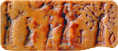
Darstellung: Dass die einheimischen Gottheiten Palästinas/Israels in der SB-Zeit auch von den ÄgypterInnen verehrt wurden, bezeugt die berühmte Mekal-Stele aus Bet-Schean (zur Datierung in die 19. Dyn. vgl. Albright 1938: 76f, n. 38; James/McGovern 1993: 240 Appendix 8). Der bärtige Stadtgott, dem Baal ähnlich und in der Inschrift als Mekal bezeichnet ( Thompson 1970a), ist thronend in ägyptischer Haltung dargestellt. Er trägt ein langes Gewand, ein Collier und eine hohe Krone mit zwei Hörnern an der Stirn und zwei am Rücken herabhängenden Bändern. In der einen Hand hält er ein Anch-Zeichen, in der anderen das Was-Zepter. Der ägyptische Architekt Amenemope, sein Sohn, der Stelenstifter Pareemheb, und weitere Familienmitglieder treten mit Lotosblüten in der Hand im Gestus der Anbetung auf den thronenden Gott zu.
Albright 1938: Albright W.F., 1938, The Excavation of Tell Beit Mirsim II. The Bronze Age (AASOR 17, 1936-37), New Haven/Conn.
James/McGovern 1993: James F.W./McGovern P.E., 1993, The Late Bronze Egyptian Garrison at Beth Shan. A Study of Levels VII and VIII, 2 vols. (University Museum Monographs 85), Philadelphia.
Thompson 1970a: Thompson H.O., 1970a, Mekal. The God of Beth-Shan, Leiden.
Parallelen: Rowe 1940: pl. 67A:4-5: der Gott von Bet-Schean scheint auch auf einer ägyptischen Fayenceschale dargestellt gewesen zu sein, auf deren Fragment Beine und ein Schurz sowie Reste einer Inschrift «Mekal, Gott von Bet-Schean» zu sehen sind.
Rowe 1940: Rowe A., 1940, The Four Canaanite Temples of Beth-Shan. Part I: The Temples and Cult Objects (Publications of the Palestine Section of the Museum of the University of Pennsylvania 2), Philadelphia.
Bibliographie: Rowe 1930: 14f, pl. 33; Rowe 1940: Frontispiz; Pritchard 1954: no. 487; Thompson 1970a: pl. 5; Fulco 1976: 22, 52f, E 52; Galling 1977: 105; Cornelius 1994: fig. 1; Keel/Uehlinger 2001: Abb. 102; Schroer 2011: 360f, Nr. 932; IDD: Mekal Nr. 1.
Cornelius 1994: Cornelius I., 1994, The Iconography of the Canaanite Gods Reshef and Ba˓al. Late Bronze and Iron Age I Periods (c 1500-1000 BCE) (OBO 140), Fribourg Switzerland/Göttingen.
Fulco 1976: Fulco W.J., 1976, The Canaanite God Rešep (American Oriental Society 8), New Haven.
Galling 1977: Galling K., ²1977, Biblisches Reallexikon, Tübingen.
IDD: Iconography of Deities and Demons in the Ancient Near East, n.d., ed. by J. Eggler and Ch. Uehlinger (in Vorbereitung; siehe: http://www.religionswissenschaft.unizh.ch/idd/)
Keel/Uehlinger 2001: Keel O./Uehlinger Ch., ⁵2001, Göttinnen, Götter und Gottessymbole. Neue Erkenntnisse zur Religionsgeschichte Kanaans und Israels aufgrund bislang unerschlossener ikonographischer Quellen, Freiburg i.Br./Basel/Wien. (erweiterte Auflage von Keel/Uehlinger 1992, ²1993, ³1995, ⁴1998)
Pritchard 1954: Pritchard J.B., 1954, ²1969, The Ancient Near East in Pictures Relating to the Old Testament, Princeton.
Rowe 1930: Rowe A., 1930, The Topography and History of Beth-Shan (Publications of the Palestine Section of the Museum of the University of Pennsylvania 1), Philadelphia.
Rowe 1940: Rowe A., 1940, The Four Canaanite Temples of Beth-Shan. Part I: The Temples and Cult Objects (Publications of the Palestine Section of the Museum of the University of Pennsylvania 2), Philadelphia.
Schroer 2011: Schroer S., 2011, Die Ikonographie Palästinas/Israels und der Alte Orient. Eine Religionsgeschichte in Bildern. Band 3: Die Spätbronzezeit, Fribourg.
Thompson 1970a: Thompson H.O., 1970a, Mekal. The God of Beth-Shan, Leiden.
DatensatzID: 7813
Permanenter Link:
https://bodo.unifr.ch/bodo/id/7813
|